While I the title of this article is a bit hyperbolic, it does make a good point. Read it.
The Worst Thing a Woman Can Call a Man

While I the title of this article is a bit hyperbolic, it does make a good point. Read it.
Like many nerds, I was quite impressed by the movie X-Men: First Class. It is easily the best movie in the X-Men franchise. What has impressed me almost as much as the movie itself are the number of reflections that I've seen regarding the justice issues in the movie and parallels with contemporary issues.
It's no secret that the struggle for mutant rights in the X-Men franchise has parallels with the civil rights, women's rights, and the gay rights movements. As a straight white male geek, this franchise gives me another way to talk to my people about the struggle for equal rights that goes around a lot of the stubbornness that comes with privilege. There are many entry points, like looking at Professor X and Magento as parallels for Martin Luther King Jr and Malcolm X, or the idea of being "outed" as a mutant as an example of being in the closet as a homosexual.
If exploring this film from the perspective of equality and justice interests you, I have come across some stimulating reviews. The first is from Ars Marginal, and reflects on the movie from the perspective of a person of color and a homosexual. The second is from Comics Worth Reading, and has a section that talks about women's rights in the film. The third is a review of the movie by a psychologist blogging on Psychology Today, exploring some of the psychological theories that come up in the movie. While the movie does revolve around issues of equality, it is not a film that achieved equality in it's production.
SPOILER ALERT: Don't read further if you haven't seen the movie.
It is a pretty white washed cast, with the one black character predictably dying soon after he is introduced, and the one latina character quickly siding with the "bad guys". The treatment of woman in the film is not that impressive. It is a period piece in the 60's, so some sexism is to be expected for accuracy's sake if not condoned, but for all the concern about mutant rights, even the mutant leaders are pretty backwards when it comes to gender issues. There is little overt reference to homosexuality in the film, though the interaction between Professor X and Magneto has long had homo-erotic overtones. Read this review for a further exploration of this idea.
END SPOILER ALERT
In short, this film is quite enjoyable and can provide great fodder to talk about justice issues with individuals who might not otherwise think about such things. But, it's easy to ask, "who was right, the Professor or Magneto?" without raising too many hackles, at least initially. 
The necessary obligations which we feel we must meet grow overnight, like Jack's beanstalk, and before we know it we are bowed down with burdens, crushed under committees, strained, breathless and hurried, panting through a never-ending program of appointments. We are too busy to be good wives to our husbands, good homemakers, good companions of our children, good friends to our friends, and with no time at all to be friends of the friendless.
But if we withdraw from public engagements and interests, in order to spend quiet hours with the family, the guilty calls of citizenship whisper disquieting claims in our ears. Our children's schools should receive our interest, the civic problems of our community need our attention, the wider issues of the nation and of the world are heavy upon us. Our professional status, our social obligations, our membership in this or that very important organization, puts claims upon us.
We're weary and breathless. And we know and regret that our life is slipping away, with our having tasted so little of the peace and joy and serenity we are persuaded it should yield to a soul of wide caliber. The times for the deeps of the silences of the heart seem so few. And in guilty regret we must postpone till next week that deeper life of unshaken composure in the holy Presence, where we sincerely know our true home is.
When Lloyd George, the British statesman, was a boy, one of his family responsibilities was to collect firewood for warmth and for cooking. He discovered early that always after a very terrific storm, with high winds and driving rain, he had very little difficulty in finding as much, and more, wood than he needed at the time. When the days were beautiful, sunny and the skies untroubled, firewood was at a a premium. Despite the fact that the sunny days were happy ones for him, providing him with long hours to fill his heart with delight, nevertheless, in terms of other needs which were his specific responsibilities, they were his most difficult times. Many years after, he realized what had been happening. During the times of heavy rains and driving winds, many of the dead limbs were broken off and many rotten trees were toppled over. The living things were separated from the dead things. But when the sun was shining and the weather was clear and beautiful, the dead and the not dead were indistinguishable.
The experience of Lloyd George is common to us all. When all is well with our world, there is often no necessity to separate the "dead" from the "not dead" in our lives. under the pressure of crisis when we need all available vitality, we are apt to discover that much in us is of no account, valueless. When our tree is rocked by mighty winds, all the limbs that do not have free and easy access to what sustains the trunk are torn away; there is nothing to hold them fast.
It is good to know what there is in us that is strong and solidly rooted. It is good to have the assurance that can only come from having ridden the storm and remained intact. Far beside the point is the why of the storm. Beside the point, too, may be the interpretation of the storm that makes of it an active agent of redemption. Given the storm, it is wisdom to know that when it comes, the things that are firmly held by the vitality of the life are apt to remain, chastened but confirmed; while the things that are dead, sterile or lifeless are apt to be torn away. The wheat and tares grow up together, but when the time of harvest comes, only wheat is revealed as wheat - and tares remain what they have been all along, tares.
Howard Thurman "The Pressure of Crisis" in Meditations of the Heart, pg 139-140
In watching the debates progress over the proposed budget in Washington, the attempt to break collective bargaining for state employees in Washington and many other economic harbinger of doom stories, I can't help but feel that something is being missed. I feel that a lot of the fear and angst over the economic woes in our country is presented in a way to artificially divide people into social classes who would be natural allies. Liberals, tea partiers, unemployed, middle class, conservatives, progressives, and so on.
This isn't to say there aren't differences but that those differences are being magnified to distract the people from the fact that we can agree on many, if not most things. We all want to feel stable and secure in our homes, jobs, and country. We know that the way of life that we have known is changing and it is frightening. The United States, the world's only remaining military superpower is having to confront that fact that it is no longer the only economic superpower. But out of that fear of change, we point at each other as the cause, instead of the larger economic forces.
To end this distraction campaign, I'm asking for people to start working together and encouraging one another to make the changes we can agree on. I'm calling them "Put Up or Shut Up" moments. If you want to be taken seriously, it is no longer enough to yell about a group that you don't agree with, but to help people make informed choices that will lead to real change.
So, here is my first "Put Up or Shut Up" suggestion. One of the causes of the financial crisis that we are in was the irresponsible behavior of the banking and lending industries. Instead of just waiting for the government to do something about this, there is one thing each of us can do to make an impact. Join a local credit union. They treat you better, your money stays in the community to help benefit others, and you can often get better rates. Go to http://moveyourmoneyproject.org/ to learn more.
From Introspective Comics: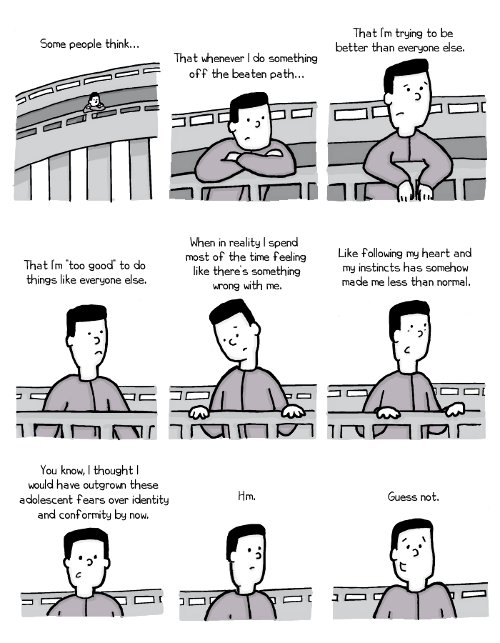
http://ryandow.com/ic/2007/03/11/everyone-else/
The Rally to Restore Sanity and or Fear
I was one of the lucky ones that went to Washington DC and attended the "Rally to Restore Sanity and or Fear." Since people have been asking how it was, here's a blog post. I'm going to start with my impressions of what the rally was about and was trying to achieve and then I will talk about the experience of being at the rally itself towards the end.
Was the rally political? Yes, insofar that politics is understood to be "a process by which groups of people make collective decisions." This was a rally designed to influence people's opinions and behaviors to improve how we work together as a society. Specifically, it was trying to get us as a nation to realize that the way the media chooses to report news and the way that politicians and pundits choose to relate to their constituents runs counter to the way we run our lives and is doing us a disservice. I'd say the rally was more about chastising the media than chastising politicians, because the media is supposed to serve as a buffer between politicians and the people. In short, the media is not doing their job by ratcheting the energy and fear up while neglecting to use editorial discretion to filter out the crazy.
Was the rally partisan? Not in the traditional sense of being for one political party over another. This seems to be where there are a lot of misconceptions in the media. Without rehashing the same discussions about the Daily Show in general, what I can give are my impressions from the rally. I was inspired to make a difference and to ratchet my own sometimes confrontational attitude back a little bit. I did not feel energized to go out there and vote Democrat or for any other party. The feeling I had, though fun and positive, was a marked contrast to how I felt being in Grant Park for Obama's election night rally. (pictures here) This rally made me realize that I miss having honest conversations about politics and society with honest, rational people who might not agree with me. At the election night rally, there was a sense of anticipation, victory and joy. At the rally to restore sanity, it was refreshing to see so many people looking for a more reasonable dialogue and a fun time. There wasn't the euphoria from the Obama rally, but there was a happy release hearing Jon Stewart say so clearly what I was feeling, that the political and media structures were getting out of hand, and working counter to the needs of the people.
This isn't to say that the rally didn't slant a bit to the left. How much you feel it slanted depends more on what you perceive to be progressive than on the content of the rally. I would describe it being mostly moderate, with much of the slant to the left from the rally attendees more than the rally presentation itself. In the interest of full disclosure, I also believe that in the last 20 years, if the facts of an issue would be examined without spin or hype, then the facts themselves would appear to lean towards the left using current standards. While what was said at the rally applies to both political parties and the media, I believe that the conservative end of the political sphere is more guilty of slanting issues and distorting data. But that's another discussion altogether.
The rally also reinforced for me the power of satire and of the jester. While Jon Stewart's speech at the end of the rally succinctly stated what his vision was and his hopes for how it would affect society, it was really the rally as a whole that drove the point home. It often gets overlooked that people's responses to politics and issues are not solely rational, but influenced by a variety of factors. While it can be said over and over that the vast majority of Muslims are not terrorists, that doesn't penetrate into the mind in the same way of the back and forth of Colbert and Stewart, attempting to defuse Colbert's increasingly irrational fears. By bringing out Kareem Abdul Jabbar, a household name for decades, as an example of how normal and accepted Muslims have been in our American culture, it brings it home in a different and more meaningful way. By using comedy, in enables us to examine our own fears and perhaps laugh at ourselves a bit more.
In a personal example, talking about the rally with my father earlier this week, the comedy made a deeper impression on him than any article I could have quoted to him. A self described independent and tea partier and a regular Fox News watcher, he was biased against the rally. By focusing on the humorous aspects of the rally, it enabled him to hear more, as he found it funny. Later in our conversation, as he'd say something unintelligent about Muslims in America, I would drop Kareem's name as a reminder. It seems to have worked. That, and giving him the facts about the proposed Muslim community center in New York City, versus the "victory mosque" on Ground Zero, but again, that's another discussion.
I don't mean to make the rally out to be a pure beacon of reasonableness and sanity in a chaos of pundits and politics. Except for the competing trains bit (peace train vs. crazy train vs. love train), most musical acts had a new album coming out, and except for the Roots, weren't that impressive. The myth busters bit, while fun (if you could hear them) was a bit of pandering to the geeky crowd. Some of the logistical critiques of the rally (poor soundsystem, lack of coordination, inadequate facilities and an overwhelmed transit system) were legitimate, though the unpolished flow was a nice change from the well choreographed political events and seemed to add a bit of legitimacy.
The thing that pleasantly surprised me the most was the diverse ages of the rally attendees. I thought it'd primarily be 20 somethings but there was a large showing of middle aged and elderly people. Also seeing a rally with a larger percentage of people of different races was nice, though it was still largely white. As I'm sure many of you have already seen, the signs were fun and inventive, (here's my pictures). Though there were a few that ripped on the tea party, Sarah Palin, Christine O'Donnell and George W. Bush, for the most part they were reasonable and as asked, brought down a notch. I did get the sense from some people that this was the closest they were going to get to a major rally for the left, and treated it as such, but mostly it was a place for moderation and sanity.
As always, it was great to see so many similarly minded people gathered in one place. Though things weren't as polite at the Obama election night rally, people were still pretty cool despite the crowds. It was amazing to see the metro trains so packed for hours before and after the rally. I wonder how many people actually came to DC to attend the rally, not just how many people actually made it to the rally.
Do I think this was a turning point? I hope so. But, if it is, it won't be a crashing wave of sanity and reasonableness, as that kind of energy seems to run counter to the whole point of the movement of calming things down. I was heartening to hear Keith Olbermann is shelving the "Worst Persons In the World" bit, and amusing for Glenn Beck to both try and minimize the rally and link it to his rally as well. With the election coming so close to the rally, it overshadowed many immediate responses, so it will be interesting to see how things settle out over time.


